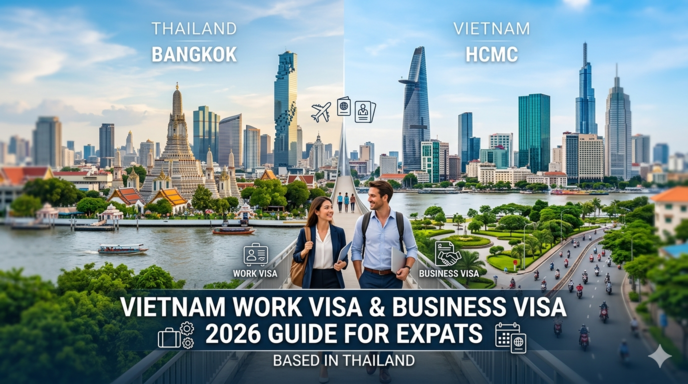
Vietnam Work Visa & Business Visa 2026: Guide for Expats Based in Thailand
If you’re an expat based in Bangkok and Vietnam is on your radar — for a role with a Vietnam-registered company, a business expansion, a regional move, or a long-term relocation — the visa and work permit landscape in 2026 is more navigable than it’s ever been. That’s the good news. The other news is that the rules changed significantly in August 2025, enforcement tightened in April 2026, and penalties for non-compliance went up sharply. This is not the time to wing it or rely on information from three years ago.
This guide covers everything that matters for expats making the Bangkok-to-Vietnam transition: the Vietnam work visa (LD), the business visa (DN), how the work permit process works under the latest regulations, who qualifies for exemptions, the Temporary Residence Card pathway, and what the Embassy of Vietnam in Bangkok actually handles versus what’s done entirely online.
The Legal Stakes in 2026: Why This Matters More Than Before
Decree 282/2025, which took effect progressively through early 2026, significantly increased the penalties for working in Vietnam without proper documentation. As of April 1, 2026, Vietnamese authorities have the power to deport foreign nationals immediately for unpaid fines related to immigration violations. The consequence structure: foreigners working without a valid work permit or exemption certificate face fines of 15 million to 25 million VND (approximately 22,000 to 37,000 baht) and can be removed from the country. Their employers face fines of 30 million to 75 million VND.
This is not hypothetical. Enforcement has intensified in Ho Chi Minh City, Hanoi, and Da Nang. The message from the Vietnamese government is clear: the path to working legally in Vietnam is better defined, faster, and less bureaucratic than before. Use it.
Vietnam Visa Types for Working Professionals
Vietnam Visa Types for Working Professionals
The LD Visa — Vietnam Work Visa
The LD visa (from the Vietnamese lao động, meaning “labor”) is the entry visa for foreign nationals entering Vietnam for employment. Under the current framework it comes in two categories:
LD1 (LĐ1): Issued to foreign nationals confirmed as not required to obtain a work permit — meaning they qualify for a work permit exemption. The exemption confirmation document from the provincial People’s Committee is required instead.
LD2 (LĐ2): Issued to foreign nationals who do hold a valid Vietnamese work permit. This is the standard category for most foreign employees at Vietnamese companies and foreign-invested enterprises.
An important 2026 update: as of early 2026, Temporary Residence Cards (TRCs) are issued only to holders of LD2 (work) and TT (dependent) visas. If your path leads to a long-term stay, the LD2 + work permit + TRC sequence is the one to plan for.
The DN Visa — Vietnam Business Visa
The DN visa covers business activities that fall short of formal employment: meetings, negotiations, business development, establishing a commercial presence, or delivering services under an international agreement.
DN1: For foreigners engaged with Vietnamese enterprises or organizations with legal status under Vietnamese law — attending board meetings, consulting with a local partner, conducting market research on behalf of a foreign company.
DN2: For foreigners entering Vietnam to provide services, establish a commercial presence, or carry out activities covered by international treaties Vietnam has ratified.
The business e-visa is a practical entry point for short-term business travel — the standard 90-day e-visa with the DN category selected at the online portal, processed in approximately three business days.
One critical limitation: the e-visa version of the DN visa cannot be converted into a work permit or Temporary Residence Card. If your Vietnam presence is escalating from short business trips to actual employment, you need to make the transition formally — not try to build a work permit application on top of a business e-visa.
The DT Visa — Investor Visa
For expats planning to invest in Vietnam rather than take employment, the DT (investor) visa is a separate category with four tiers based on investment amount, and validity ranging from 12 months to 5 years. Bangkok-based investors looking at Vietnam’s manufacturing, technology, or real estate sectors should examine the DT pathway separately — it has its own documentation requirements and is processed differently from work or business visa tracks.
The Work Permit: What Changed in August 2025
Decree 219/2025/ND-CP, effective August 7, 2025, replaced the previous framework established by Decree 152/2020 and its amendments. Here is what actually changed, in plain terms:
The two-step process became one step. Previously, employers first sought approval to hire a foreign national, then applied separately for the work permit. Under Decree 219, these are merged into a single dossier submitted once to the provincial authority.
The approval authority moved from central to provincial. The Ministry of Labor, Invalids and Social Affairs (MOLISA) no longer handles work permit approvals. Authority has been fully decentralized to the provincial People’s Committee where the employer is registered.
The statutory timeline was shortened from 15 to 10 working days. A well-prepared application with complete documentation should return a decision within two calendar weeks.
The process is now fully online. Applications are submitted through the national online portal. No physical submission to a government ministry window.
Qualification criteria were relaxed for experts and technical workers. An “expert” now needs a university degree and two years of relevant experience (down from three), or in priority sectors — science, technology, innovation, digital transformation — only one year. A “technical” worker needs two years of experience with one year of vocational training (previously three years), or three years of experience without a degree (previously five).

Vietnam Work Visa & Business Visa 2026: Guide for Expats Based in Thailand
What Your Employer Must Submit
The work permit application is always employer-sponsored. A foreign national cannot apply independently. The sponsoring company submits:
- Business registration certificate (certified copy)
- Introduction / guarantee letter from the company’s authorized representative, with signature and seal
- Completed visa and work permit application form with full personal and employment details
- Copies of educational qualifications — apostilled or consular-legalized and translated into Vietnamese
- Criminal background check from your home country — notarized, legalized, and dated within six months of application
- Health examination certificate from a designated Vietnamese hospital (includes HIV test and drug screening)
- Certified copies of your passport bio-data page and photographs
The document preparation phase — apostilling degrees, obtaining criminal record certificates, arranging translations — typically takes four to eight weeks when coordinating from Bangkok. Start collecting documents when you begin serious employment discussions, not after you’ve signed the offer.
Work Permit Exemptions: Who Doesn’t Need One
Not every foreign national working in Vietnam needs a full work permit. Decree 219 expanded the exemption categories. Current exemptions include:
- Owners or members of an LLC with a capital contribution of at least 3 billion VND
- Chairpersons or Board members of a joint-stock company
- Foreigners working in Vietnam for fewer than 30 consecutive days (maximum 90 days per year) on short-term assignments or trade fairs
- Intra-company transferees from a foreign parent to a Vietnamese subsidiary, under specific conditions
- Experts in science, technology, and national digital transformation fields under Decree 219’s expanded categories
Important: qualifying for an exemption does not mean skipping the administrative process. You still need a Confirmation of Work Permit Exemption (WEPC) from the relevant provincial authority before employment begins. Your employer handles this application.
The Pathway to a Temporary Residence Card (TRC)
For expats planning to stay beyond six to twelve months, the TRC eliminates the need for repeated visa renewals. The sequence: LD2 visa → Work Permit (at least 12 months validity) → TRC application
The TRC replaces the visa function entirely during its validity, gives multiple-entry and exit rights without returning to the Embassy, and functions as a practical ID for daily life — opening bank accounts, leasing property, administrative procedures. The TRC for LD1/LD2 visa holders is valid for up to two years and is renewable.
TRC document requirements:
- Valid LD2 visa
- Work permit with at least 12 months remaining validity
- Notarized copy of employer’s business registration certificate
- Application forms NA8/NA9
- Original passport (at least one year validity; two years if applying for a two-year TRC)
- Temporary residence registration from your accommodation address
- Health check from a Vietnamese hospital
- Criminal record certificates from your home country and Vietnam
- Passport photographs
Processing time: 5–15 working days. Applications are submitted at the provincial Immigration Department or via the national Public Service Portal. As of July 2025, TRC holders must also register for VNeID — Vietnam’s national digital identity system — as a mandatory linked step.
The Embassy of Vietnam in Bangkok: What It Actually Handles
The Embassy of Vietnam in Bangkok (83/1 Wireless Road / Witthayu Road, Lumpini) handles official consular functions: sticker visa issuance for categories requiring physical endorsement in the passport, document legalization and authentication (consular legalization as an apostille alternative), document certification, notarization, and official diplomatic correspondence.
What the Embassy does not handle:
Standard 90-day tourist or business e-visa: Processed entirely online through Vietnam Immigration’s portal. The Embassy on Wireless Road cannot issue these.
Work permit approvals: Processed by the provincial People’s Committee in Vietnam where the employer operates. The Embassy plays no role in the permit decision.
Where the Bangkok Embassy is genuinely useful: Consular legalization of your home-country documents (degrees, criminal clearance) if Vietnam does not accept apostille for your specific documents. This step in your work permit document preparation may require a trip to Wireless Road. Confirm which documents need Embassy legalization versus apostille before assuming either route works.
Embassy consular hours: weekday mornings and early afternoons — confirm current hours by phone before visiting, as these change periodically and the Embassy is closed on both Thai and Vietnamese public holidays.
Digital Nomads and the E-Visa Reality
A significant portion of Bangkok-based expats in Vietnam work remotely for foreign employers — earning salaries in foreign currencies, living in Vietnam on the 90-day e-visa, and cycling with periodic border exits.
The legal reality: if you are employed by a foreign company (not registered in Vietnam) and your income is paid outside Vietnam, you do not require a Vietnamese work permit. The e-visa supports this arrangement. The practical rhythm: a 90-day multiple-entry e-visa ($50 at the online portal), with a border exit approaching expiry — a flight back to Bangkok or a bus to the Moc Bai / Poipet border crossing into Cambodia — and re-entry on a fresh 90-day period.
What is not legal: working for a Vietnamese company, earning income from Vietnamese clients as a service provider registered in Vietnam, or filling an employment role at a Vietnam-registered business — on an e-visa, without a work permit. Enforcement under Decree 282/2025 has made this a genuinely risky position from April 2026 onward.
💡 Expert Insight from Stanley Ho: “Over my 23+ years handling travel logistics and Vietnam visa services, the most frequent disruption occurs at the check-in desk due to simple application formatting errors. If you are stuck at the airport and denied boarding, don’t panic — our emergency team can secure a new E-visa clearance through priority channels within hours, saving your flight.”
Application Timeline: Bangkok to Vietnam for Work
6–8 weeks before start date: Collect home-country documents. Criminal background check from your home-country authority (or your home country’s Bangkok embassy). University degree certificates. Confirm whether Vietnam accepts apostille for your country’s documents or whether consular legalization via the Bangkok Embassy is required.
4–6 weeks before start date: Your Vietnam employer submits the single-dossier work permit application to the provincial People’s Committee under Decree 219’s merged process. Statutory processing: 10 working days.
After work permit approval: Your employer applies for the LD2 visa. You may receive a visa certificate to present at the Vietnamese border on arrival, or the visa is issued as an electronic endorsement.
After 6–12 months working in Vietnam: Apply for the Temporary Residence Card at the provincial Immigration Department. This eliminates further visa renewals for up to two years.
Vietnam Work Visa & Business Visa 2026
Frequently Asked Questions
Can I apply for a Vietnam work permit myself from Bangkok? No. Work permit applications are always employer-sponsored. The sponsoring Vietnamese company submits the dossier to the provincial People’s Committee. You cannot apply independently, and the Bangkok Embassy does not process work permits. Your role is to provide personal documents (passport, degrees, criminal clearance, health check results) to your employer for inclusion in the dossier.
How long does the Vietnam work permit process take under Decree 219? Statutory processing time is 10 working days from the date the provincial People’s Committee receives a complete dossier — approximately two to three calendar weeks. Add four to eight weeks for document collection and preparation, and you’re looking at six to ten weeks total from starting preparations to being legally ready to work.
What is the difference between the DN visa (business) and the LD visa (work)? The DN visa covers business activities without formal employment: meetings, negotiations, consulting visits. The LD visa covers formal employment — you hold a role at a Vietnam-registered company with a Vietnamese work permit (LD2) or exemption (LD1). A DN visa cannot be converted into a work permit or TRC, and working in an employment capacity on a DN visa violates its terms.
Do I need a work permit if I work remotely for a foreign company while living in Vietnam? If your employer is a foreign company (not registered in Vietnam) and your income is paid outside Vietnam, no work permit is required. You may live in Vietnam on the 90-day multiple-entry e-visa, renewable by periodic border exits. If you work for a Vietnamese company or earn income from Vietnamese clients as a locally-registered service provider, the work permit requirement applies.
What are the penalties for working in Vietnam without a work permit in 2026? Under Decree 282/2025, you face fines of 15–25 million VND (approximately 22,000–37,000 baht) and potential deportation. From April 1, 2026, immediate deportation for unpaid fines is authorized. Your employer faces fines of 30–75 million VND. Enforcement has intensified in all major Vietnamese cities.
About the Reviewer: Stanley Ho is the CEO of VisaOnlineVietnam and a recognized expert consultant in the international aviation and travel service industry. With 23+ years of experience in travel logistics and Vietnam visa services, Stanley and his team specialize in providing seamless visa solutions, fast-track airport services, and emergency travel assistance for global citizens visiting Vietnam.