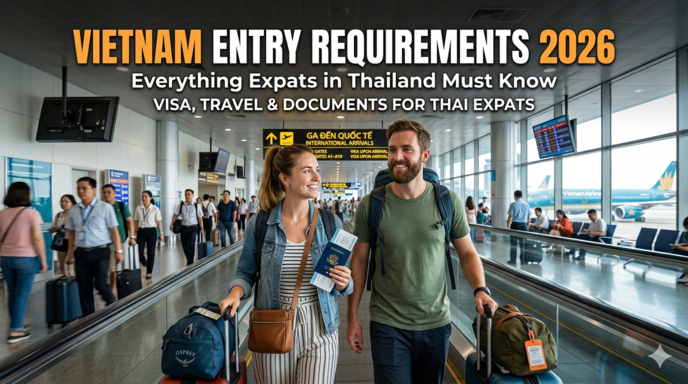
Vietnam Entry Requirements 2026: Everything Expats in Thailand Must Know
Vietnam’s entry framework changed more in the twelve months between mid-2025 and mid-2026 than it did in the five years before that. New decrees on overstay penalties. A Digital Arrival Card launched at Ho Chi Minh City’s busiest airport in April 2026. Two brand-new visa categories announced for July 2026. Forty-one additional entry ports added to the e-visa acceptance list. And an important 2026 clarification on how the e-visa entry and exit dates actually work — a misunderstanding that is quietly responsible for more unintentional overstays than almost any other factor.
If you’re an expat based in Bangkok — whether you’re Thai, British, Indian, American, Australian, or any other nationality — this is the comprehensive update you need before your next Vietnam trip. I’ll organize it around the questions I hear most from clients in Thailand: Which entry track applies to me? What do I need at the airport? What can go wrong, and how expensive does it get if it does?
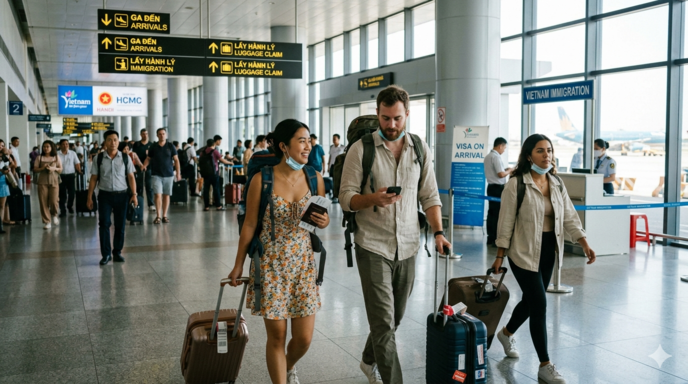
Vietnam Entry Requirements 2026: Complete Guide
Step One: Which Entry Track Applies to You?
Vietnam’s entry system in 2026 runs on three tracks. Which track you use depends entirely on your passport nationality — not where you live, not how long you’ve been in Bangkok. The tracks are: visa-free exemption, e-visa, and long-term visa.
Track 1 — Visa-Free Exemption (selected nationalities only)
Vietnam offers unilateral visa-free entry to a growing list of nationalities. As of mid-2026, the major exemption categories are:
45-day visa-free exemption (expanded from August 15, 2025 to August 14, 2028): Germany, France, Italy, Spain, United Kingdom, Russia, Japan, South Korea, Denmark, Sweden, Norway, Finland, Belarus, Poland, Czech Republic, Switzerland, Belgium, Bulgaria, Croatia, Hungary, Luxembourg, Netherlands, Romania, Slovakia, and Slovenia. Citizens of these countries may enter Vietnam for tourism or business for up to 45 days without applying for any visa. No registration, no fee, no approval letter — just a valid passport.
30-day visa-free exemption (ASEAN): Thailand, Singapore, Malaysia, Indonesia, Philippines, Brunei, Cambodia, Laos, and Myanmar. Thai passport holders fall here. Thirty days, no application required, applies at all international entry ports including airports, land borders, and seaports.
14-day visa-free exemption: Selected other bilateral agreement countries.
Important rules that apply to all visa-free exemptions without exception:
- Your passport must have at least 6 months of validity remaining from your arrival date in Vietnam. Airlines at Suvarnabhumi (BKK) check this at check-in and will deny boarding if this requirement is not met — no exceptions.
- You must have at least one blank page for an immigration stamp.
- Airlines in Thailand — Thai Airways, Bangkok Airways, VietJet — routinely ask visa-exempt travelers to show proof of onward or return travel before issuing a boarding pass. It’s not always an immigration requirement but it is a consistent airline requirement. Have your return flight booking accessible.
- Overstaying a visa-free exemption, even by a single day, is a violation that leaves a permanent record in Vietnam’s immigration database.
The Phu Quoc special case: All nationalities — including those not on any exemption list — receive a 30-day visa-free stay if they fly directly to Phu Quoc International Airport (PQC) and remain on the island throughout their stay. The moment you fly or travel to the mainland, the exemption no longer covers you. This is a frequently misunderstood rule that catches travelers who plan to “see Phu Quoc then visit Ho Chi Minh City” on the same trip without realizing the Phu Quoc exemption doesn’t cover the mainland leg.
Track 2 — Vietnam E-Visa (all other nationalities, and the flexible option for everyone)
Since August 2023, the Vietnam e-visa has been open to citizens of all countries and territories worldwide — no nationality restrictions. The current e-visa specifications:
- Duration: Up to 90 days per stay
- Entry type: Single or multiple entry (your choice at application)
- Fee: $25 USD, paid online
- Processing time: 3 working days standard; emergency processing (2–4 hours) available through expedited services for urgent travel
- Entry ports accepted: 83 international entry points as of December 2025 — up from 42 previously — including all major international airports, 33 land border crossings, and multiple seaports
The e-visa is the right option for any nationality not on the exemption list, and also for nationals who are exempt but want a longer stay than their exemption allows (a British passport holder with a 45-day exemption who needs 70 days, for example, should apply for the e-visa instead).
The entry/exit date distinction — read this carefully. The e-visa specifies an entry date and an exit date. These dates are fixed when the visa is issued. If your e-visa entry date is May 1 and exit date is July 29, you may enter Vietnam on or after May 1 — but if you enter on May 10, you do not get nine extra days at the back end. Your exit date remains July 29. Arriving later than your entry date does not move the clock. This is the most common source of accidental overstays among e-visa holders, and under Decree 282/2025, the fines are not trivial.
The port-specific rule for Bangkok travelers. The e-visa specifies a primary entry port. You must enter Vietnam through the port listed on your visa, or through one of the 83 accepted e-visa ports. The most critical practical implication: if you’re flying from Bangkok (BKK or DMK) to Vietnam, the entry port on your e-visa must match your actual arrival airport in Vietnam. Arriving at Da Nang (DAD) on an e-visa that lists Ho Chi Minh City (SGN) as the entry port will result in boarding denial at the Bangkok check-in counter. Airlines verify this in real time. Select your actual arrival airport when applying.
Track 3 — Long-Term Visas (work, investment, skilled professionals)
For expats in Bangkok who are relocating to Vietnam for employment or investment, the relevant visa categories are the LD visa (work), DN visa (business), and DT visa (investor) — covered in detail in our [Vietnam Work Visa & Business Visa 2026 guide].
New from July 1, 2026: Two new visa categories — UĐ1 and UĐ2 — will be introduced by the Vietnamese government. The UĐ1 visa targets high-quality digital technology professionals and special talent foreign nationals, with validity up to five years. The UĐ2 covers the spouse and children under 18 of UĐ1 holders. These categories are designed to attract Vietnam’s next generation of skilled foreign labor in the technology sector, and represent the most significant expansion of the long-term visa framework since 2023.
The Digital Arrival Card at Ho Chi Minh City — Mandatory Since April 15, 2026
This is the entry requirement that most travel guides published before May 2026 do not mention, because it didn’t exist. As of April 15, 2026, most foreign nationals arriving at Tan Son Nhat International Airport (SGN) in Ho Chi Minh City must submit a Vietnam Digital Arrival Card (DAC) before clearing immigration.
Here is exactly what it is and what it isn’t:
What it is: A free online pre-arrival declaration — Vietnam’s equivalent of Singapore’s SGAC or Malaysia’s MDAC — that collects your passport details, flight number, visa information, and accommodation address in Vietnam. You submit it online, receive a QR code, and present the QR code to the immigration officer on arrival.
What it is not: A visa. The DAC does not grant entry and does not replace the e-visa or any exemption requirement. Both are required independently for travelers who need a visa.
Where: Currently mandatory only at Tan Son Nhat (SGN) in Ho Chi Minh City. Noi Bai (HAN) in Hanoi, Da Nang (DAD), Cam Ranh (CXR), and Phu Quoc (PQC) are not yet covered, though the Vietnam Immigration Department has confirmed a nationwide rollout following the SGN pilot period.
When to complete it: Within 72 hours before your departure for Vietnam. Not before. Not two weeks in advance.
Who must complete it: All foreign nationals clearing immigration at SGN. This includes visa-exempt travelers — the exemption does not waive the DAC requirement. Vietnamese citizens traveling on Vietnamese passports and airside transit passengers who do not clear immigration are exempt.
How to complete it: The form is hosted on the official Vietnam Immigration Department portal at prearrival.immigration.gov.vn — free, no third-party fee required. One form submission can cover a group of travelers (families, tour groups). After submission you receive a QR code confirmation. Save it to your phone and screenshot it as a backup. A mobile display is sufficient; printing is optional.
What happens if you forget it: Immigration can retrieve your record manually, but this causes significant delays at the counter — especially at SGN where peak-time queues can already run 500+ people. The system is designed to replace the slow manual data-entry process; arriving without a pre-submitted QR adds you back into the slowest processing lane.
For Bangkok-based travelers routing through SGN (Tan Son Nhat), this step is now as mandatory as checking in for your flight. Add it to your pre-departure checklist.
Overstay Fines in 2026: What Decree 282/2025 and Decree 59/2026 Changed
Overstaying in Vietnam was always a violation. In 2026, it became significantly more expensive, and in certain cases, it triggers immediate deportation.
Under Decree 282/2025 (effective December 15, 2025) and Decree 59/2026 (effective April 1, 2026), the current fine structure for overstaying a visa or visa exemption is:
| Overstay Duration | Fine (VND) | Approximate THB |
|---|---|---|
| 1–15 days | 500,000 – 2,000,000 | 750 – 3,000 |
| 16–29 days | 3,000,000 – 5,000,000 | 4,500 – 7,500 |
| 30–60 days | 5,000,000 – 10,000,000 | 7,500 – 15,000 |
| 60 days to 6 months | 10,000,000 – 25,000,000 | 15,000 – 37,500 |
| Over 6 months | Up to 40,000,000 | up to 60,000 |
For overstays of 1–2 days, you can proceed directly to the airport and pay at the immigration counter before departure — approximately 500,000 VND ($22) — without needing to visit an Immigration Office. For longer overstays, you must attend the Immigration Department in person, pay the fine, and obtain an Exit Visa before you can depart. The process takes additional time.
Under Decree 59/2026 (effective April 1, 2026), overstays exceeding 16 days may result in immediate deportation enforcement. Severe or repeated violations trigger blacklisting with re-entry bans of 1 to 5 years. These entries are permanent in Vietnam’s immigration database and affect future e-visa applications, work permit approvals, and in some cases Temporary Residence Card eligibility.
For expats doing extended stays in Vietnam on e-visas: The single most common overstay trap is misreading the e-visa validity. Your exit date is printed on the visa. It is not “90 days from arrival.” It is a fixed calendar date. If you entered the country five days after your visa start date, you did not gain five days — you lost them. Check your exit date the moment you receive your e-visa, set phone reminders for two weeks before it, and apply for an extension (if available) at least 7–10 working days before it expires.
Passport Requirements and What Airlines Check at Bangkok Airports
Beyond the visa question, Bangkok-based travelers need to be aware of what gets checked at the departure counter — because airlines at Suvarnabhumi and Don Mueang apply their own verification layer before immigration ever sees your documents.
Passport validity: Minimum 6 months remaining from your Vietnam arrival date. This is non-negotiable. With a passport expiring in, say, October 2026, you cannot travel to Vietnam in May 2026 if your stay extends into November. Airlines check this. If they flag it, you don’t board.
Blank passport pages: At least one blank page for entry and exit stamps. Seasoned travelers in Asia with heavy stamp histories should check this before booking.
E-visa entry port match: As discussed, your e-visa must list the airport you’re landing at in Vietnam. This is checked in real time at check-in.
Onward travel: Visa-exempt travelers are routinely asked at Bangkok check-in to show proof of a return flight or onward booking leaving Vietnam before their exemption expires. Have this accessible — not buried in an email folder.
The “Pending” e-visa problem: If you applied online and your e-visa status still shows “Processing” or “Pending” at check-in time, the airline cannot issue a boarding pass. Processing delays happen, particularly around Vietnamese public holidays and major travel periods. Apply at least 5 working days before departure. If you’re within 24–72 hours of your flight and your visa hasn’t arrived, emergency processing through an expedited service is the fastest resolution.
💡 Expert Insight from Stanley Ho: “Over my 23+ years handling travel logistics and Vietnam visa services, the most frequent disruption occurs at the check-in desk due to simple application formatting errors. If you are stuck at the airport and denied boarding, don’t panic — our emergency team can secure a new E-visa clearance through priority channels within hours, saving your flight.”
E-Visa Ports: The Full 83-Point Network (Key Points for Bangkok Travelers)
As of December 2025, Vietnam’s e-visa is accepted at 83 international entry and exit points — up from the original 42. For Bangkok-based travelers, the most relevant entry points are:
International airports (e-visa accepted): Noi Bai / Hanoi (HAN), Tan Son Nhat / Ho Chi Minh City (SGN), Da Nang (DAD), Cam Ranh / Nha Trang (CXR), Phu Quoc (PQC), Can Tho, Vinh, Phu Cat (Quy Nhon), Tuy Hoa, Lien Khuong (Da Lat), Cat Bi (Hai Phong), Van Don (Quang Ninh).
Key land borders (e-visa accepted): Moc Bai (Tay Ninh – Cambodia), Bavet / Moc Bai is the main overland route from Bangkok via Phnom Penh. Ha Tien (Kien Giang – Cambodia). Lao Bao (Quang Tri – Laos). Nam Can / Dong Khau (Nghe An – Laos). Cau Treo (Ha Tinh – Laos). And 28 other approved land crossings.
This expansion is particularly useful for Bangkok-based travelers planning overland Southeast Asia routes — the days of needing a consular sticker visa for land border entry are effectively over for e-visa holders.
The Priority Visa Exemption Program (Decree 221/2025)
For expats with professional profiles that align with Vietnam’s development priorities, Decree 221/2025 introduced a long-term priority visa exemption program covering experts, investors, highly skilled individuals, artists, businesspersons, and individuals who contribute to Vietnam’s economic development. This program allows multiple entries during its validity period, with exemption cards valid for up to 5 years.
This is not a tourist visa. Eligibility is determined by relevant Vietnamese authorities and requires an application process. For Bangkok-based professionals considering a long-term Vietnam presence without the formal work permit track — investors, consultants, technology experts — this program is worth investigating as an alternative pathway. It is distinct from and parallel to the UĐ1/UĐ2 five-year professional visa launching July 1, 2026.
VIP Fast-Track: Skip the Queue at Vietnam’s Busiest Entry Points
With the Digital Arrival Card now live at SGN and immigration modernization expanding to other airports, the priority processing lane matters more than ever for Bangkok travelers with tight connection schedules.
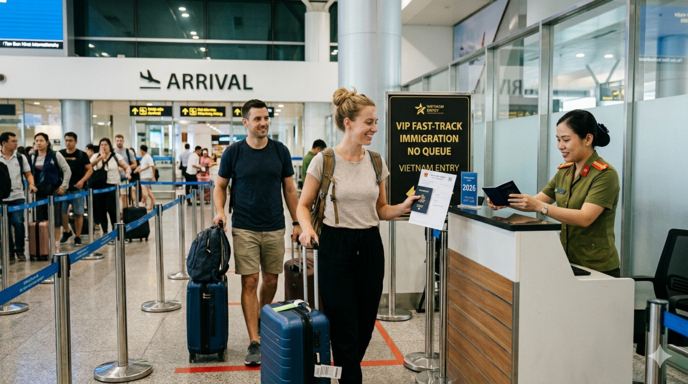
Vietnam Entry Requirements 2026: Everything Expats in Thailand Must Know
The VIP Airport Fast-Track service provides a personal concierge who meets you at the aircraft gate, escorts you through a dedicated priority immigration lane, and completes your passport formalities before the standard queue forms. At SGN — where standard immigration can back up to 500+ passengers during evening peaks — this service can save 45–90 minutes. Available at: SGN (Ho Chi Minh City), HAN (Hanoi), DAD (Da Nang), CXR (Cam Ranh), and PQC (Phu Quoc).
For families, executives, and anyone connecting from Bangkok on a tight schedule, pairing the e-visa with VIP Fast-Track is the complete entry solution.
Vietnam Entry Requirements: Quick Reference by Nationality
| Nationality | Entry Track | Duration | Application |
|---|---|---|---|
| Thai passport | Visa-free ASEAN | 30 days | None |
| UK, Germany, France, Italy, Spain (& 20 more EU) | Visa-free exemption | 45 days | None |
| Japan, South Korea | Visa-free exemption | 45 days | None |
| USA, Canada, Australia, New Zealand, India | E-visa required | Up to 90 days | Online, $25 |
| All other nationalities | E-visa required | Up to 90 days | Online, $25 |
| Any nationality to Phu Quoc only | Phu Quoc exemption | 30 days | None |
Note: All figures current as of May 2026. Verify before travel as Vietnam’s exemption list continues to expand.
Frequently Asked Questions
Do Thai nationals need a visa for Vietnam in 2026? No. Thai passport holders enter Vietnam visa-free for up to 30 days under the ASEAN bilateral agreement. No application, no fee, no approval document. Your passport must have at least 6 months of validity remaining from your Vietnam arrival date, and you must have at least one blank page for a stamp. Airlines at Suvarnabhumi will ask for proof of a return or onward flight before issuing your boarding pass. If you want to stay longer than 30 days, you need the 90-day e-visa — applied online before you fly.
What is the Vietnam Digital Arrival Card and do I need it? The Vietnam Digital Arrival Card (DAC) is a mandatory free online pre-arrival declaration launched at Tan Son Nhat Airport (SGN) in Ho Chi Minh City on April 15, 2026. If you are a foreign national clearing immigration at SGN, you must submit it within 72 hours before departure at prearrival.immigration.gov.vn. You receive a QR code to show at the immigration counter. The DAC is not a visa and does not replace any visa or exemption requirement — both are needed independently. Currently only mandatory at SGN; HAN, DAD, CXR, and PQC are not yet covered but a nationwide rollout is planned.
My e-visa says 90 days — does that mean 90 days from when I arrive? No, and this misunderstanding is responsible for a large number of overstays. The 90-day e-visa has a fixed entry date and a fixed exit date specified at issuance. If your visa entry date is June 1 and you arrive in Vietnam on June 10, your exit date does not move — it remains 89 days after June 1. You effectively have 80 days of stay, not 90. Always calculate from the exit date printed on your visa, not from your actual arrival date.
What happens if my e-visa is still “Processing” when my flight from Bangkok is tomorrow? Contact an emergency visa processing service immediately. Do not call the airline, do not go to the gate hoping for the best. The airline’s check-in system verifies e-visa approval status in real time — a “Pending” status results in boarding denial. Emergency processing through a direct-to-Immigration expedited channel typically delivers an approved e-visa within 2–4 hours. Standard operating hours at the Bangkok Embassy are not relevant for this — the process is online and operates 24/7.
Can I enter Vietnam overland from Bangkok through Cambodia on an e-visa? Yes. The Moc Bai border crossing (Tay Ninh province, Vietnam side) is one of the 83 approved e-visa entry points. The overland route from Bangkok via Phnom Penh and then to Ho Chi Minh City through Moc Bai is fully e-visa compatible. The journey takes approximately 14–16 hours from Bangkok by bus, or you can fly Bangkok–Phnom Penh and then take the overland connection. Ensure your e-visa lists a valid entry port — you can list Moc Bai or Ho Chi Minh City (as the broader entry zone), but verify the exact selection during application.
What are the new overstay fines in Vietnam for 2026? Under Decree 282/2025 (effective December 2025) and Decree 59/2026 (effective April 1, 2026), fines range from VND 500,000 for a 1–15 day overstay up to VND 40,000,000 for overstays exceeding six months. From April 1, 2026, overstays of 16 days or more may trigger immediate deportation. Severe or repeated violations result in re-entry bans of 1–5 years logged permanently in Vietnam’s immigration database.
About the Reviewer: Stanley Ho is the CEO of VisaOnlineVietnam and a recognized expert consultant in the international aviation and travel service industry. With 23+ years of experience in travel logistics and Vietnam visa services, Stanley and his team specialize in providing seamless visa solutions, fast-track airport services, and emergency travel assistance for global citizens visiting Vietnam.