Vietnam Multiple Entry E-Visa 2026: The Complete Guide for Frequent Travelers from Thailand
If you’re researching the Vietnam visa for Thailand frequent travelers in 2026 — specifically the multiple-entry option — you’ve landed in exactly the right place. Thai nationals enjoy a generous 30-day visa exemption under ASEAN agreements. Free, automatic, no paperwork. But here’s the thing nobody tells you upfront: the moment your Vietnam travel goes beyond that single short trip, the 30-day exemption becomes your biggest trap, not your biggest advantage.
Business trips that run long. A second visit planned the same quarter. A slow-travel lifestyle split between Bangkok and Ho Chi Minh City. Suddenly that free 30-day stamp feels claustrophobically short, and every re-entry means another exemption clock ticking down from zero. The Vietnam 90-day multiple-entry E-visa changes that math entirely — one application, one approval, and you move between Thailand and Vietnam as freely as your schedule demands, for three solid months.
This guide is written specifically for Thai passport holders who travel to Vietnam regularly. Whether you fly out of Suvarnabhumi (BKK), Don Mueang (DMK), Phuket (HKT), or Chiang Mai (CNX), the process is the same. Online. Straightforward. And — if you get the details right — remarkably painless.
Why the 30-Day ASEAN Exemption Isn’t Enough Anymore
Let’s be direct. The free 30-day entry sounds fantastic until you’re a frequent traveler. Then it stops being a privilege and starts being a scheduling headache.
Consider the scenarios: You’re managing a project across both countries and need three separate trips in one quarter. Or you’re a digital nomad treating Ho Chi Minh City and Bangkok as twin home bases. Or you run a business with partners in both markets and every trip bleeds past the four-week mark. In all of these situations, the 30-day ASEAN stamp simply doesn’t serve you. You’re either cutting trips short, overstaying (a serious immigration offense with real consequences), or going through the exhausting ritual of exiting and re-entering to reset the clock.
The 90-day multiple-entry Vietnam E-visa exists precisely for people like you. One application, one approval — and for the next three months, Vietnam is an open door. Enter. Leave. Return. Enter again. No fresh applications, no embassy visits, no approval letters, no airport stamp queues. The digital visa is tied to your passport and recognized at all 83 official E-visa entry points across Vietnam’s international airports, land crossings, and seaports.
Vietnam Multiple Entry E-Visa Requirements for Thai Citizens
The good news: Thailand sits comfortably on Vietnam’s universal E-visa eligible list, meaning Thai passport holders can apply without any additional documentation proving eligibility. The requirements are clean and straightforward.
What you need to apply:
- A valid Thai passport with at least 6 months of validity beyond your intended arrival date in Vietnam
- At least 2 blank visa pages remaining in your passport
- A passport-quality photograph (4x6cm, white background, no glasses, taken within the last 6 months — the portal is strict)
- A clear scan of your passport’s biographical data page
- A valid email address for the approval notification
- A credit or debit card (Visa, Mastercard, or JCB) to pay the government fee
Processing time and cost:
Standard processing runs 3 to 5 business days. The government fee for a multiple-entry E-visa is $50 USD — a one-time cost for 90 days of unrestricted in-and-out travel. If you need it faster, urgent processing through specialist services like VisaOnlineVietnam can deliver clearance in as little as 2 to 4 hours. That’s not a typo. Emergency same-day service, for when your itinerary doesn’t wait.
One important note for frequent travelers: the Vietnam E-visa is not extendable once you’re inside the country. The 90 days are the ceiling. If you need more time in Vietnam after that period, you exit, reapply, and start fresh. Plan accordingly.
Denied Boarding at Suvarnabhumi (BKK): What Happens When Your Visa Isn’t Ready
Picture this. It’s 6:15 AM at Suvarnabhumi Airport. You’re third in line at the check-in counter, carry-on already slung over your shoulder, coffee cooling in your hand. The agent scans your passport, types something, pauses. Types again. Then turns to you with that particular expression that sends a cold drop straight through your chest.
“Sir, I’m not showing a valid Vietnam visa for this passport.”
You have a flight to Tan Son Nhat (SGN) in under three hours. The next available flight isn’t until tomorrow. Your meeting in Ho Chi Minh City starts at 2 PM.
This scenario isn’t hypothetical. It plays out weekly at BKK and Don Mueang (DMK) — often not because the traveler forgot to apply, but because a formatting error triggered a rejection they never noticed, or because the 3-business-day standard processing wasn’t quite fast enough for a last-minute itinerary change.
The rescue, when it comes, looks like this: a Super Urgent E-Visa service that bypasses standard processing queues and secures a fresh approval through priority channels, in 2 to 4 hours. If you’re stranded at Suvarnabhumi or Don Mueang right now, do not accept the situation as final. Contact an emergency visa processing service immediately.
💡 Expert Insight from Stanley Ho: “Over my 23+ years handling travel logistics and Vietnam visa services, the most frequent disruption occurs at the check-in desk due to simple application formatting errors. If you are stuck at the airport and denied boarding, don’t panic — our emergency team can secure a new E-visa clearance through priority channels within hours, saving your flight.”
The Thai Passport Trap: Name Formatting Errors That Kill Applications
Thai names are extraordinarily beautiful. They are also, with respect, a documented minefield for Vietnam’s E-visa portal — and this section could save your application from rejection before it even reaches a reviewer.
The core issue is transliteration. Thai script uses a romanization system that can produce very long first and last names when rendered in English. The Vietnam E-visa portal has strict character limits per field, and compound names — particularly the long polysyllabic surnames common in Thai culture — frequently overflow those limits when pasted directly from a Thai passport.
Here’s what can go wrong: your full legal name as printed on your Thai passport might be “Wanchalerm” or “Thanathorn Juangroongruangkit.” Both are entirely valid Thai names. But the E-visa portal may truncate the last name, split the fields incorrectly, or flag the entry as a mismatch against the machine-readable zone of your passport. Any discrepancy, however slight, is grounds for rejection — or worse, a boarding denial when the airline’s system fails to match your visa to your travel document.
The fix is simple but non-negotiable: enter your name exactly as it appears in the Roman-script fields of your Thai passport. Not your nickname, not your shortened form used for business cards. Exactly as printed. If your passport shows “JUANGROONGRUANGKIT” in the surname field, that exact string — no abbreviations, no hyphens substituted, no spaces inserted — goes into the E-visa surname field.
If your passport has a particularly long surname that appears truncated even in the official document itself, take a photo of the data page and the machine-readable zone at the bottom, and flag it explicitly when applying through a professional visa service. A human reviewer can catch and resolve these edge cases before they reach the immigration system.
Skip the Queue: VIP Fast-Track at Vietnam’s Airports
Frequent travelers know that the visa is only half the immigration experience. The other half is the arrival queue — and at peak times, Tan Son Nhat (SGN) and Noi Bai (HAN) can test the patience of even the most seasoned road warrior. Thirty minutes in a slow-moving line after a two-hour flight from Bangkok is nobody’s idea of efficiency.
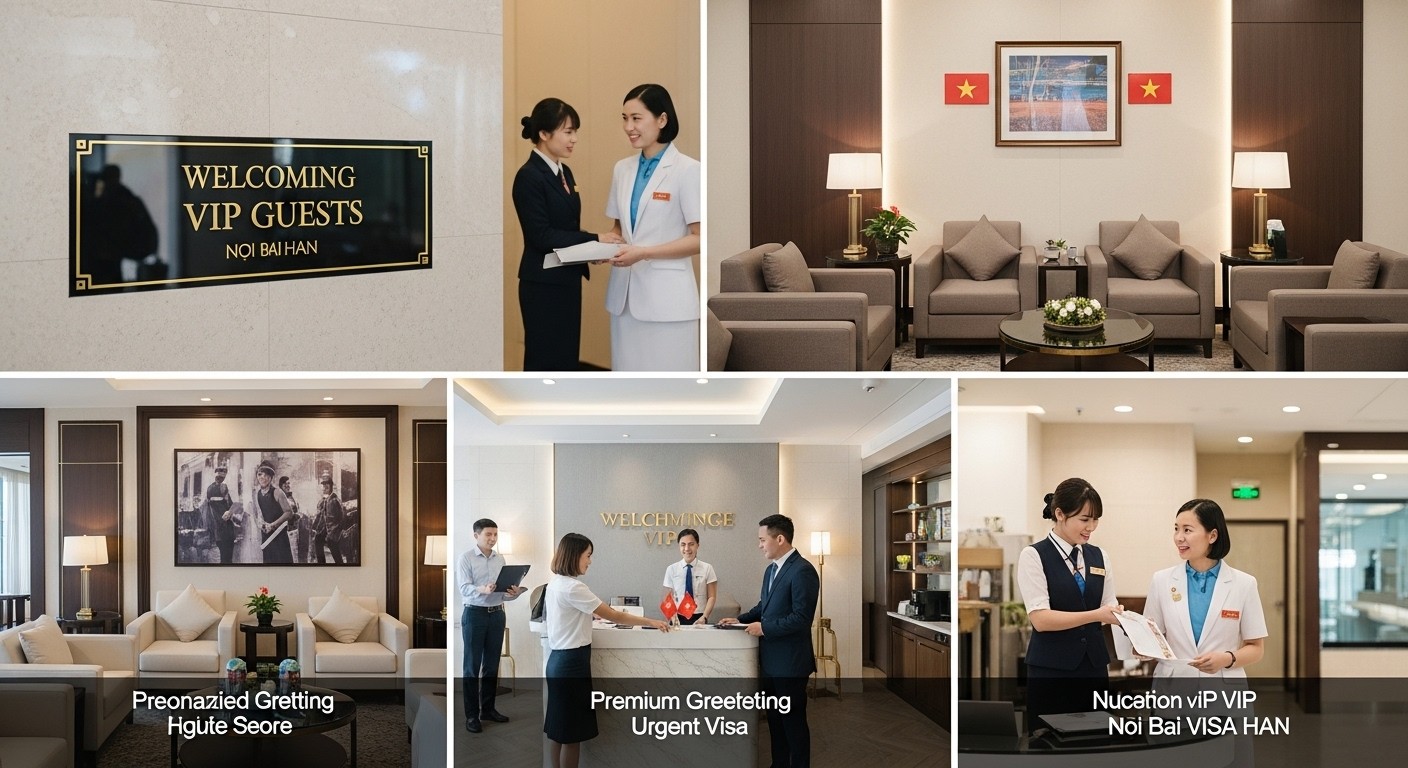
The VIP Airport Fast-Track service is the straightforward solution. Book it in advance and a dedicated airport concierge meets you as you step off the plane — at the gate, before you ever join the general immigration queue. They escort you directly to a priority immigration lane reserved for VIP arrivals. Your passport. Your E-visa. A few seconds of processing. Done.
Available at all major Vietnam international entry points used by Thai travelers — Tan Son Nhat (SGN) in Ho Chi Minh City, Noi Bai (HAN) in Hanoi, Da Nang International (DAD), Cam Ranh (CXR) near Nha Trang, and Phu Quoc (PQC) for island arrivals — the service is less a luxury than a productivity tool for anyone visiting Vietnam on a tight professional schedule. Time saved at immigration is time that goes back into your day, your meetings, your beach walk. Take it.
How to Apply for the Vietnam Multiple Entry E-Visa from Thailand
The application is entirely online. No embassy visit required — and I mean that emphatically. The Vietnam Embassy in Bangkok handles diplomatic matters and sticker visas for special cases, but standard tourist and business E-visas are managed by Vietnam’s Immigration Department portal. There is no reason whatsoever to queue at an embassy in 2026.
Here’s the process, step by step:
- Go to the official portal or a trusted specialist service. The official Vietnam Immigration portal (evisa.xuatnhapcanh.gov.vn) processes applications directly. A specialist service like VisaOnlineVietnam handles document review and formatting checks before submission — useful for frequent travelers who want human verification against common Thai passport issues.
- Fill in your personal details carefully. Your name, date of birth, nationality, passport number, and passport expiry date must match your Thai passport data page exactly. Double-check. Then check again. Select “Multiple Entry” and a stay duration of 90 days.
- Specify your intended entry point. Your E-visa will be issued for a specific entry port. Frequent Bangkok–HCMC travelers typically select Tan Son Nhat (SGN). If you fly into multiple Vietnam cities, select the port for your first entry — you can exit and re-enter through any E-visa-approved port after that.
- Upload your photo and passport scan. The photo must meet Vietnam Immigration standards: 4x6cm, plain white background, face centered, no glasses, no headwear (religious exceptions acknowledged), taken within 6 months. The passport scan must show all four corners of the data page, clearly legible, without flash glare washing out the printed data.
- Pay the $50 USD government fee. Visa, Mastercard, or JCB. Payment is non-refundable whether your application is approved or rejected, which is another reason to get the details right before submitting.
- Receive your approval by email. Standard processing: 3 to 5 business days. Urgent processing: 2 to 4 hours. Once approved, download the PDF. Vietnam immigration accepts both a printed copy and a digital version displayed on your phone — though for frequent travelers, having both is the sensible habit.
Frequently Asked Questions
Do Thai citizens need the Vietnam multiple-entry E-visa if they only visit once?
No. If your trip to Vietnam is a single stay of 30 days or under, your Thai passport gets you in automatically under the ASEAN exemption. No visa required, no application, no fee. The 90-day multiple-entry E-visa is the right tool when you plan multiple trips in a quarter, when your stay will exceed 30 days, or when you need the certainty of a confirmed entry authorization before flying rather than relying on the exemption stamp at arrival.
Can I get a Vietnam multiple-entry E-visa if I’m still using my 30-day exemption on a current trip?
Yes. You can apply for the E-visa from anywhere — including while you’re already in Vietnam on your exemption stamp. Just ensure your passport still has 6 months of validity and that the E-visa approval arrives before your current exemption expires. Do not overstay; the penalties are real and can affect future entry eligibility.
What happens if my name in the E-visa doesn’t exactly match my Thai passport?
This is the scenario you want to avoid at all costs. Vietnamese immigration systems perform an automated name match between your E-visa and your passport’s machine-readable zone. Even a single character discrepancy — a space, a missing letter, a truncated surname — will flag your document and can result in boarding denial or entry refusal. If it happens, an emergency re-application through a priority service is your fastest recovery route.
Can I apply for a Vietnam multiple-entry E-visa as a frequent traveler from Thailand for business trips?
Absolutely. The Vietnam E-visa in 2026 covers both tourism and business purposes under the same document. Select “Business” as the purpose of visit during application if your trips are work-related. The 90-day multiple-entry validity makes it particularly well-suited to business travelers who shuttle between Bangkok and Ho Chi Minh City or Hanoi on regular schedules.
Is Visa on Arrival still an option for Thai travelers going to Vietnam in 2026?
The old Visa on Arrival approval letter system — where you paid a third-party service for a letter, printed it out, and then queued for a stamp at the Vietnam airport — is completely dead and should not be considered. It adds unnecessary cost, airport queue time, and a layer of administrative friction that the E-visa entirely eliminates. If someone recommends VOA letters to you in 2026, they haven’t updated their advice in several years.
About the Reviewer: Stanley Ho is the CEO of VisaOnlineVietnam and a recognized expert consultant in the international aviation and travel service industry. With 23+ years of experience in travel logistics and Vietnam visa services, Stanley and his team specialize in providing seamless visa solutions, fast-track airport services, and emergency travel assistance for global citizens visiting Vietnam.